Last Update:
How to join or concat ranges, C++26
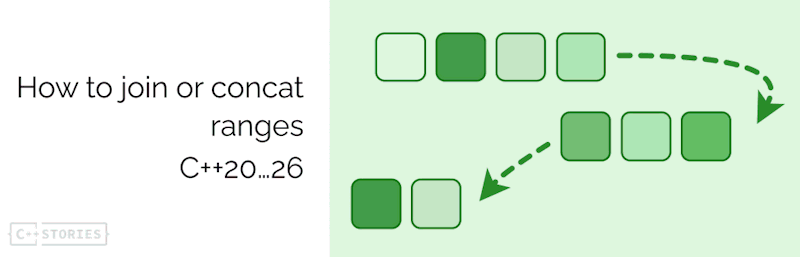
Table of Contents
Modern C++ continuously improves its range library to provide more expressive, flexible, and efficient ways to manipulate collections. Usually, when you wanted to concatenate or flatten ranges, you’d use raw loops or custom algorithms. With C++’s range adaptors, we now have an elegant and efficient way to process collections lazily without unnecessary allocations.
In this post, we will explore three powerful range adaptors introduced in different C++ standards:
std::ranges::concat_view(C++26)std::ranges::join_view(C++20)std::ranges::join_with_view(C++23)
Let’s break down their differences, use cases, and examples.
Updated in May 2026: added from_range construction options.
std::ranges::concat_view (C++26)
The concat_view allows you to concatenate multiple independent ranges into a single sequence. Unlike join_view, it does not require a range of ranges-it simply merges the given ranges sequentially while preserving their structure.
In short:
- Takes multiple independent ranges as arguments.
- Supports random access if all underlying ranges support it.
- Allows modification if underlying ranges are writable.
- Lazy evaluation: No additional memory allocations.
See the example:
#include <print>
#include <ranges>
#include <vector>
#include <array>

int main() {
    std::vector<std::string> v1{"world", "hi"};
    std::vector<std::string> v2 { "abc", "xyz" };
    std::string arr[]{"one", "two", "three"};

    auto v1_rev = v1 | std::views::reverse;
    auto concat = std::views::concat(v1_rev, v2, arr);

    concat[0] = "hello"; // access and write

    for (auto& elem : concat)
        std::print("{} ", elem);
}
See at @Compiler Explorer
The output:
hello world abc xyz one two three
The example below shows how to concatenate three ranges, v1 is reversed and then combined with v2 and arr. Notice that we can also access the value at position 0 and update it.
And a bit more complex example:
#include <print>
#include <ranges>
#include <vector>
#include <list>
#include <string>

struct Transaction {
    std::string type;
    double amount;
};

int main() {
    std::vector<Transaction> bank_transactions{
       {"Deposit", 100.0},
       {"Withdraw", 50.0},
       {"Deposit", 200.0}
    };
    std::list<Transaction> credit_card_transactions{
        {"Charge", 75.0}, {"Payment", 50.0}
    };

    auto filtered_bank = bank_transactions
        | std::views::filter([](const Transaction& t) {
        return t.amount >= 100.0;
    });

    auto filtered_credit = credit_card_transactions
        | std::views::filter([](const Transaction& t) {
        return t.amount > 60.0;
    });

    auto all_transactions = std::views::concat(filtered_bank, filtered_credit);

    for (const auto& t : all_transactions)
        std::println("{} - {}$", t.type, t.amount);
}
std::ranges::join_view (C++20)
The join_view is designed for flattening a single range of ranges into a single sequence. It removes the structural boundaries between nested ranges.
- Works on a single range of ranges (e.g.,
std::vector<std::vector<int>>). - Does not support
operator[](no random access). - Eliminates boundaries between sub-ranges.
- Lazy evaluation, avoiding memory copies.
A simple example:
#include <iostream>
#include <ranges>
#include <vector>

int main() {
    std::vector<std::vector<int>> nested{{1, 2}, {3, 4, 5}, {6, 7}};
    auto joined = std::views::join(nested);

    for (int i : joined)
        std::println(i);
}
The output:
1 2 3 4 5 6 7
Of course, we can have different nested ranges… and this can be handy for string processing:
#include <print>
#include <ranges>
#include <vector>
#include <string>
#include <map>

int main() {
    std::vector<std::string> words { "Hello", "World", "Coding" };

    // regular:
    std::map<char, int> freq;
    for (auto &w : words)
        for (auto &c : w)
            freq[::tolower(c)]++;

    // join:
    std::map<char, int> freq2;
    for (auto &c : words | std::views::join)
        freq2[::tolower(c)]++;

    for (auto& [key, val] : freq2)
        std::println("{} -> {}", key, val);
}
As you can see, thanks to views_join we can save one nested loop and iterate through a single range of characters.
std::ranges::join_with_view (C++23)
The join_with_view works like join_view, but it allows inserting a delimiter between flattened sub-ranges.
- Works on a single range of ranges.
- Allows specifying a delimiter (single element or a range).
- Does not support random access.
- Useful for formatting strings or separating collections.
See the example below:
#include <iostream>
#include <ranges>
#include <vector>
#include <string>
#include <string_view>

std::string to_uppercase(std::string_view word) {
    std::string result(word);
    for (char& c : result)
        c = std::toupper(static_cast<unsigned char>(c));
    return result;
}

int main() {
    std::vector<std::string_view> words{
        "The", "C++", "ranges", "library"
    };

    auto words_up = words | std::views::transform(to_uppercase);
    auto joined = std::views::join_with(words_up, std::string_view(" "));

    for (auto c : joined)
        std::cout << c;
}
See at Compiler Explorer
Here’s the expected output:
THE C++ RANGES LIBRARY
Creating new containers from the view
I think I overlooked one important aspect of our experiments.
It’s good that we can print flattened or concatenated ranges… but what if you want to create another container from that view?
A simple example could be as follows:
std::vector<int> make_flat(const std::vector<std::vector<int>> &nested) {
 // ??
}

auto new_vector = make_flat(vec_vec);
We have at least four options here:
- Before C++23, we can push data to the new container in some loop,
- Or pass
begin()andend()iterators, - For C++23, we can use
ranges::to(), - Or, also for C++23, create container directly from a range/view.
See the example here:
#include <print>
#include <ranges>
#include <string>
#include <string_view>
#include <vector>

std::vector<int> make_flat_loop(const std::vector<std::vector<int>>& nested) {
    std::vector<int> out;
    for (int value : nested | std::views::join)
        out.push_back(value);
    return out;
}

std::vector<int> make_flat_iters(const std::vector<std::vector<int>>& nested) {
    auto joined = nested | std::views::join;
    return { joined.begin(), joined.end() };
}

std::vector<int> make_flat_to(const std::vector<std::vector<int>>& nested) {
    return nested
        | std::views::join
        | std::ranges::to<std::vector<int>>();
}

std::vector<int> make_flat_from_range(const std::vector<std::vector<int>>& nested) {
    auto joined = nested | std::views::join;
    return std::vector<int>(std::from_range, joined);
}

int main() {
    std::vector<std::vector<int>> nested{{1, 2}, {3, 4, 5}, {6, 7}};
    auto flat1 = make_flat_loop(nested);
    auto flat2 = make_flat_iters(nested);
    auto flat3 = make_flat_to(nested);
    auto flat4 = make_flat_from_range(nested);

    for (auto&& flat : {flat1, flat2, flat3, flat4}) {
        for (int value : flat)
            std::print("{} ", value);
        std::println("");
    }

    std::vector<std::string> words{"C++", "ranges", "are", "powerful"};
    auto sentence = std::string(
        std::from_range,
        std::views::join_with(words, std::string_view(" "))
    );

    std::println("{}", sentence);
}
The output:
1 2 3 4 5 6 7
1 2 3 4 5 6 7
1 2 3 4 5 6 7
1 2 3 4 5 6 7
C++ ranges are powerful
The C++23 changes came from the following proposal: P1206R7 - Conversions from ranges to containers.
Comparing concat_view, join_view, and join_with_view
| Feature | concat_view ✅ |
join_view ✅ |
join_with_view ✅ |
|---|---|---|---|
| Works on multiple independent ranges? | ✅ | ❌ | ❌ |
| Flattens nested ranges? | ❌ | ✅ | ✅ |
| Supports separators between sub-ranges? | ❌ | ❌ | ✅ |
| Random access support? | ✅ (if all inputs support it) | ❌ | ❌ |
Summary
C++’s range adaptors provide efficient ways to manipulate collections without unnecessary copying. Here’s a quick summary of when to use each view:
- Use
concat_viewwhen merging multiple independent ranges. - Use
join_viewwhen flattening a range of ranges. - Use
join_with_viewwhen flattening a range of ranges but needing a separator between elements.
References
Books:
- C++23 Best Practices - by Jason Turner
- Modern C++ Programming Cookbook - by Marius Bancila
- Programming: Principles and Practice Using C++ - by Bjarne Stroustrup
Other:
- std::ranges::join_view - cppreference.com
- std::ranges::join_with_view - cppreference.com
- std::ranges::concat_view - cppreference.com
Back to you
- Do you use ranges?
- What are your most useful views ald algorithms on ranges?
Share your comments below
I've prepared a valuable bonus for you!
Learn all major features of recent C++ Standards on my Reference Cards!
Check it out here: